
Gwinnett Resident Lookup Sources
Each official record confirms a narrow fact. The county assessor connects an owner with a parcel, while a deed proves a recorded transfer or interest. A court docket shows that a person appeared in a case under a stated role. Georgia My Voter Page verifies one voter who supplies the required identifiers. Probate and vital records document life events, but access to certified certificates depends on the requester and record type.
| Record | Fact It Can Confirm | Official Keeper | Access Route |
|---|---|---|---|
| Property assessment | Owner, parcel, situs and mailing address | Gwinnett Board of Assessors | Free portal or office |
| Deed index | Party tied to a recorded land transfer | Superior Court Clerk and GSCCCA | Remote index; office viewing |
| Court docket | Party role, case number and case events | Gwinnett court clerks | Portal, re:SearchGA, or counter |
| Voter record | Individual registration and districts | Georgia SOS and Gwinnett Elections | MVP or lawful records request |
| Probate or vital record | Estate role or eligible life-event record | Probate Court or Georgia DPH | Index, file request, mail, online, or counter |
| Business or license filing | Public entity role or credential status | Georgia Secretary of State | Free online index |
Choose the first source by the question. An address points toward the assessor. A case number belongs at the court portal. A deceased relative may lead to probate. A professional credential or company role belongs in a state index. This keeps a resident lookup focused and reduces false matches.
Confirming Gwinnett Resident Identity
Do not join records on a name alone. Gwinnett County has a large and diverse population, so compound surnames, spacing, hyphens, initials, suffixes, married names, and more than one naming order can all affect results. Search sensible variants, but never infer identity or background from the spelling of a surname.
- Write the full name plus one independent anchor, such as a middle initial, approximate age, former address, relative, or business.
- Check the Gwinnett assessor if ownership may connect the person to a parcel. Keep mailing and situs addresses separate.
- Compare a recent deed, court date range, probate role, or public business filing. Stop when two core details conflict.
- Request the source document from its custodian when an index entry is not enough.
A homestead indicator can support an owner-occupancy conclusion, but it does not identify every adult in a household. A registered-agent address may be a service office. These details are leads, not shortcuts to certainty.
Searching Gwinnett Resident Court Records
The Gwinnett Courts portal hub routes users to Superior, State, Magistrate, and Probate estate searches, as well as re:SearchGA for available documents. Recorder's Court has a distinct search. Federal cases use PACER, not the county portal. Search a resident by party or business name, then narrow by court, case category, filing period, or case number when available.
| Search control | How it helps |
|---|---|
| Case number | Provides the most precise route to one docket |
| Party or business name | Finds candidates; test initials and name variants |
| Court or category | Separates civil, criminal, estate, and other case groups |
| Filing date range | Reduces same-name results |
A docket can show the court, case type, filing date, party roles, judge, attorney, events, hearings, status, disposition, and available document links. It does not prove a current address. Allegations are not findings. Sealed, juvenile, adoption, and other confidential material will not appear.
The official Gwinnett Probate records page shows the archived-book and file-request route:
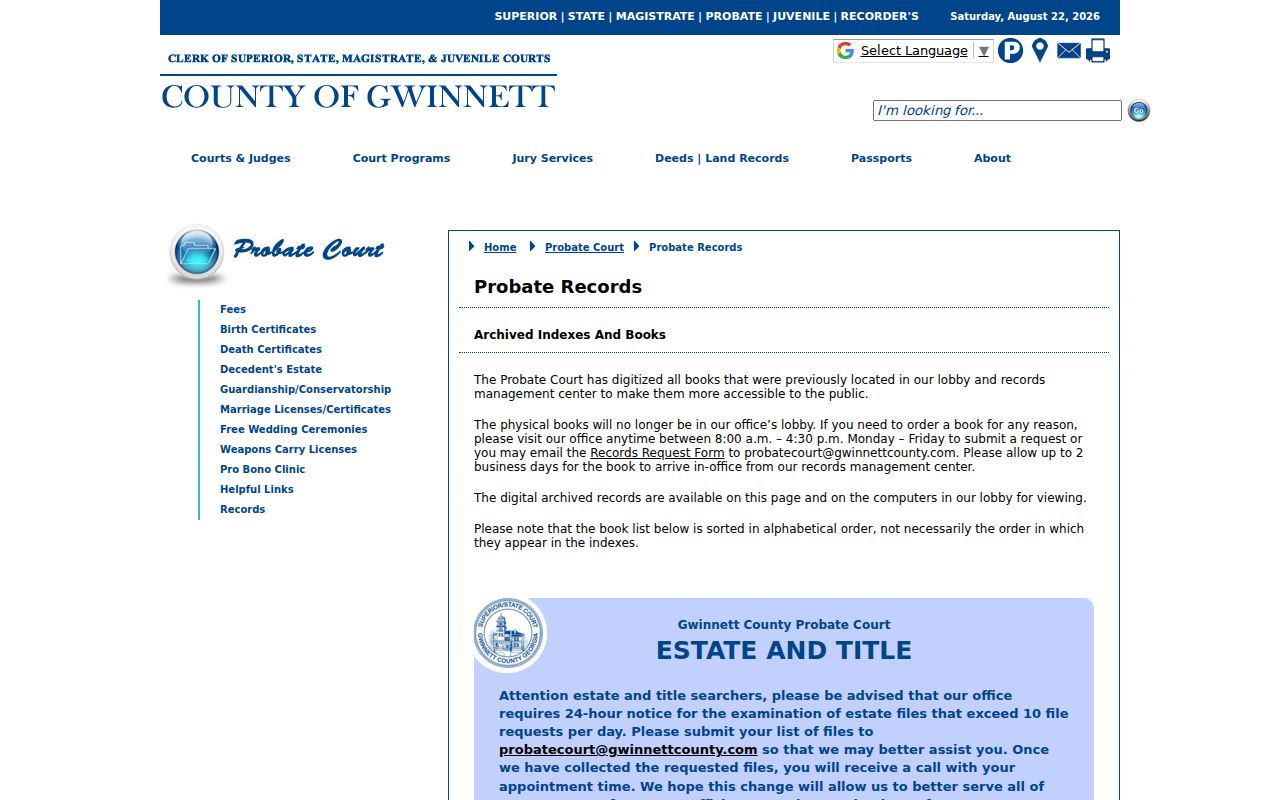
The page is useful after a name leads to an estate, but larger file pulls need planning: requests over ten files require advance notice, and stored books may take two business days.
Note: A case index identifies a filing; only the clerk's document can show what was actually alleged, ordered, or resolved.
Reading Gwinnett Lookup Results
A few terms prevent costly mistakes. The index is a finding tool, not always the record itself. Read the party role and date before assuming the result belongs to the resident being sought.
- Docket
- The dated list of filings and events in a court case.
- Index versus image
- An index points to a record through names and reference numbers. The image is the filed document.
- Certified copy
- A copy authenticated by the custodian for a formal need.
- Situs address
- The physical location of a parcel, which may differ from the owner's mailing address.
Common resident lookup results should be inventoried before comparison: case number, court, filing date, party name and role, event history, status, and document links for a docket; or owner, parcel ID, situs, mailing address, deed reference, and exemption indicator for an assessment. Matching two fields is safer than matching a display name.
Gwinnett Voter Lookup Is Individual
Georgia My Voter Page is an individual verification tool. It asks for a first initial, last name, county, and date of birth. It is not a public block directory. Georgia also does not register voters by party. A primary-participation field shows which primary ballot was selected for an election, not a party membership or any vote choice.
Gwinnett Elections handles information questions separately from requests for copies. The full voter-list route is governed by O.C.G.A. §§ 21-2-225 and 21-2-225.1. Sensitive details are withheld, commercial use is barred, and protected addresses may be absent. A non-match cannot prove that a person has no Gwinnett County connection.
That distinction is a useful myth check. MVP can add one verified fact when the searcher already has the required details. It cannot be browsed to discover everyone with a similar name.
Gwinnett Vital Records Require Proof
Georgia does not provide a general public birth-name index for a resident lookup. Birth certificates are limited to eligible requesters under O.C.G.A. § 31-10-26. Death certificates, especially cause-of-death information, have requester limits under § 31-10-15. The correct route depends on the event and date: Gwinnett Probate handles local certificates and county marriage records, while Georgia DPH holds statewide birth and death records and marriages from 1952 through 1996.
The Gwinnett birth-certificate page sets out the local eligibility and identification route:
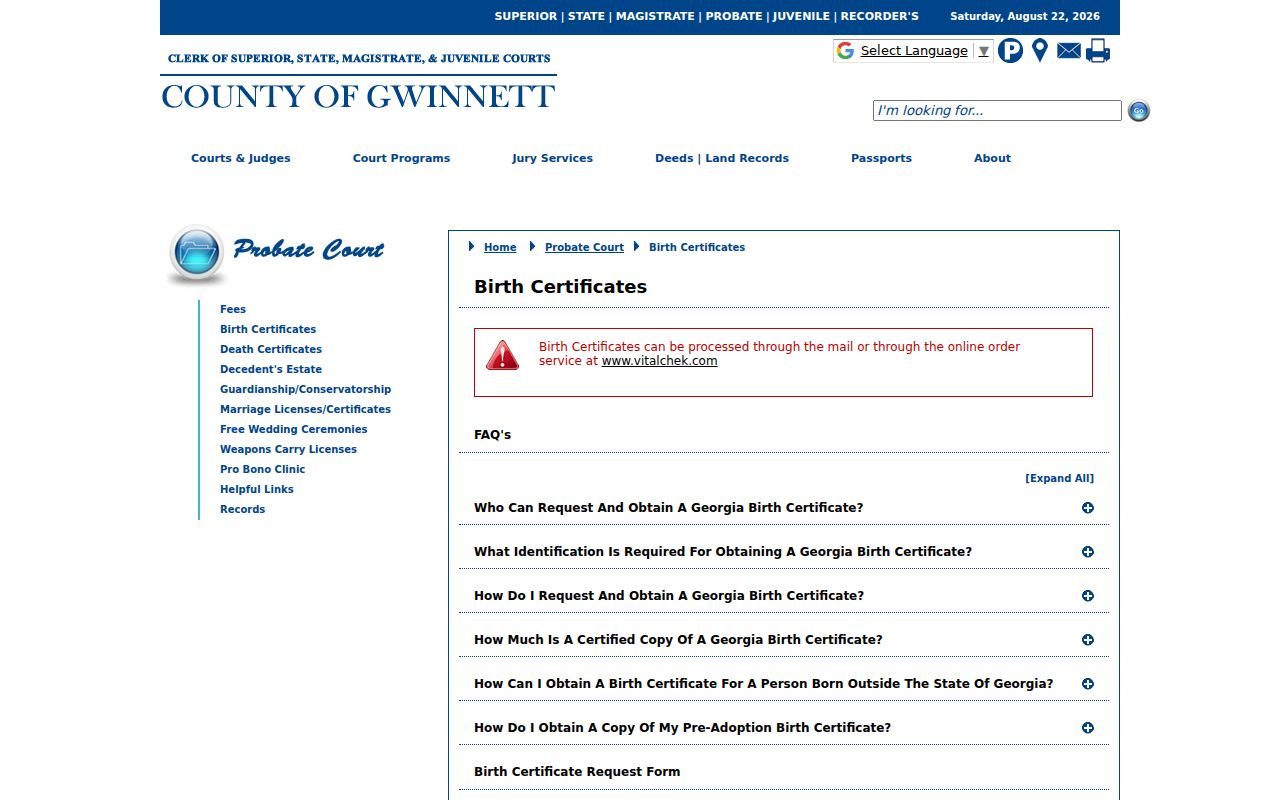
An application asks for the name at birth, date and county of birth, sex, parents' names, the requester's relationship, contact details, identification, signature, and payment. A restricted certificate is not the same as a historical public index.
Marriage records also follow a real custodian path. Gwinnett Probate Court accepts a counter or mail request for a county certificate. A divorce confirmation from DPH is not the decree; the Superior Court clerk holds that case file.
Finding Gwinnett Heirs Through Probate
Probate is often the strongest lawful path when someone is tracing an estate or looking for family after a death. Public petitions, notices, wills, and estate files may connect a decedent with an executor, administrator, or heirs. Begin with the decedent's full name and an approximate death period, inspect the digitized archived books or estate search, then request the actual file.
Pair that file with an obituary or article from Gwinnett County Public Library microfilm services. The library can take a targeted obituary request and lets users print, save, or email reader images. A newspaper relationship should be checked against probate or vital evidence before two people are treated as the same family.
Personal use. Probate can help reconnect relatives and settle estate questions, but sealed adoption material and protected family details must remain closed.
Confirming Gwinnett Business Connections
The Georgia Business Search can match a name with an entity, registered agent, officer, control number, status, and public filing details. The Georgia professional license search accepts profession, license type, first or middle name, last name, and license number. Its advice is to use fewer fields, and a trailing asterisk can broaden a name search.
These indexes confirm a public business or credential link. They do not prove that a business address, registered-agent office, or facility is a person's home. Gwinnett trade-name filings are held by the Superior Court clerk, while an unincorporated county business-license record may require a request when no public index answers the question.
Requesting Missing Gwinnett Resident Records
When an online search fails, use the correct counter, mail route, or records officer. The county open-records portal covers executive departments such as Elections and Planning, but it excludes Superior, State, and Magistrate clerk records. Judicial files must go to the court clerk.
Under the Georgia Open Records Act, O.C.G.A. §§ 50-18-70 through 50-18-77, an agency generally produces records or responds within three business days. Ask for an existing record, not a new resident list. Give the office, record type, full name and variants, address if relevant, a narrow date span, and the preferred electronic format. If the county cannot produce the record at once, it should describe the response and timetable.
This court exclusion often explains a false dead end. Sending a court-file request through the county portal delays the search because the wrong custodian received it.
Lawful Gwinnett Resident Lookup Limits
Safe at Home gives eligible survivors a substitute address and mail forwarding so a residential address need not appear in participating government records. Georgia voter law also protects qualifying addresses. Motor-vehicle personal information is restricted by the federal DPPA. Utility and delivery account data should not be treated as a public directory.
Correct an error with the office that created the source record. Commercial compilations can be stale, combine namesakes, and hide their sources. Original custodians provide the sounder route for verification and correction.
Lawful use. Use a Gwinnett County resident lookup for legitimate personal research. Never use public information to stalk, harass, threaten, impersonate, or evade an address-protection program.